

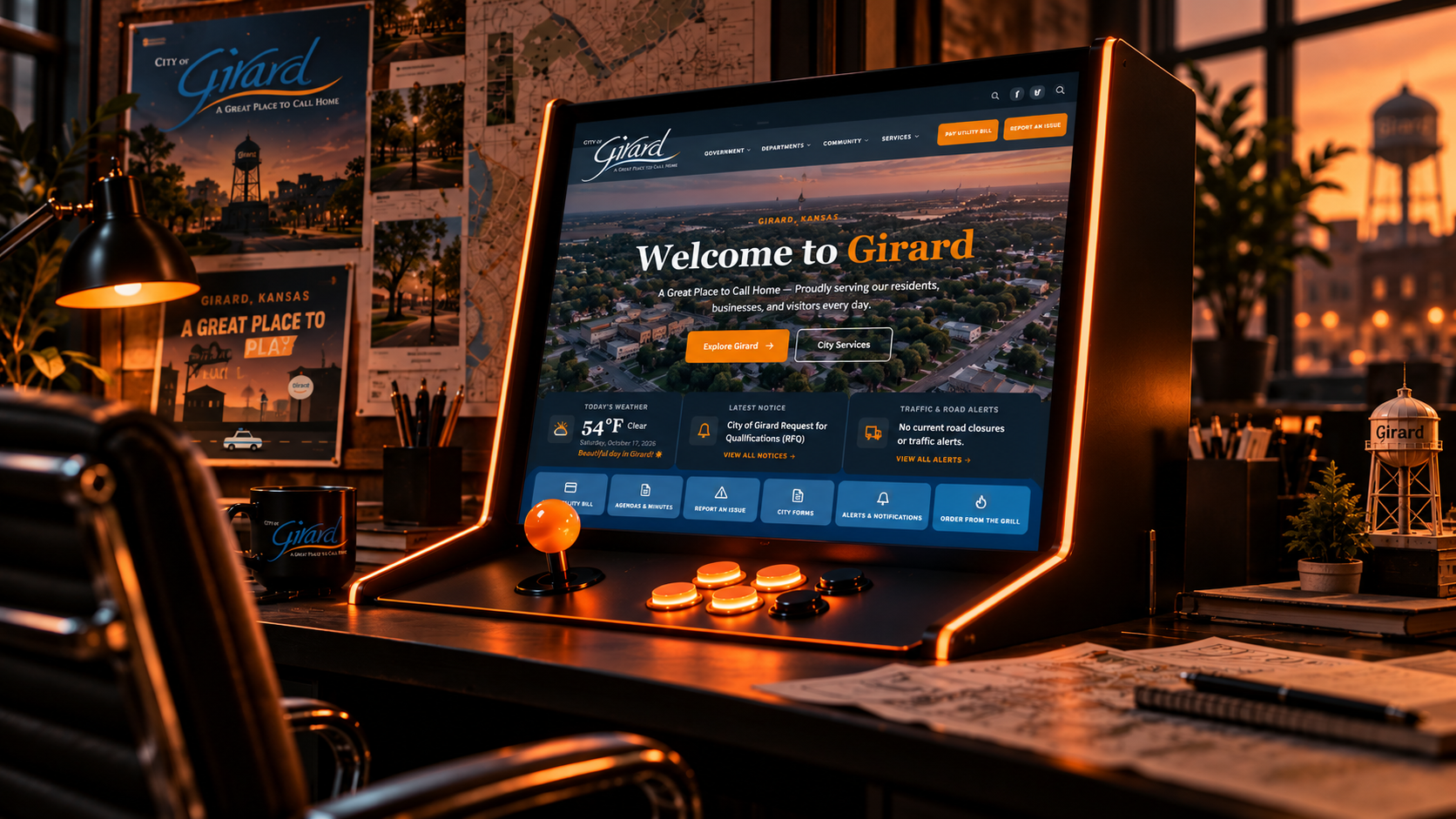
Somewhere in Southeast Kansas, there's a city website that helps people find local services, look up information and take care of everyday business. Pretty normal stuff for a municipal website.
It also has an arcade game tucked inside.
Yes, an actual game. On a government website. We know how that sounds.
When we worked on the City of Girard, Kansas website, the serious part of the assignment was clear. Residents needed easier access to city information and services. The city needed a site that looked better, worked better on phones and was easier for staff to manage. We built around those needs, with custom development, photography, video, accessibility work and a more intuitive approach to finding information.
And somewhere along the way, we decided a little arcade wouldn't hurt.
First, the Boring Stuff That Isn't Actually Boring
Government websites have a difficult job. One visitor wants to find a utility form. Another needs a department's phone number. Someone else is looking for city news, upcoming events or information about a local service. None of those people should need a guided tour to get where they're going.
That's what makes the work interesting to us. A city website isn't just a brochure with a nice photograph of Main Street. It's a collection of everyday tasks, and those tasks have to be handled carefully.
If a resident is trying to find important information, we don't want the navigation to be clever in the wrong way. We want it to be obvious. If a city employee needs to update a page, we don't want that task to require a call to the developer. We want the tools to make sense.
Accessibility matters, too. Being able to navigate with a keyboard, read content clearly and use the site comfortably on different devices isn't the flashy part of a project, but it's part of doing the job correctly.
So why add a game to a website that already has plenty to accomplish?
Because we also believe a city deserves a personality.
A City Is More Than a List of Departments
Think about how most municipal websites introduce their communities. You get a seal, a welcome message, a few links to departments and maybe a photograph taken during a ribbon-cutting ceremony. The information might all be there, but the place itself doesn't always come through.
That feels like a missed opportunity.
A community has its own character, inside jokes, familiar landmarks, traditions and things people take pride in. The website can reflect that without making visitors fight through an elaborate experience just to find a form.
For Girard, our broader approach was to make the website feel welcoming and memorable while keeping the useful stuff front and center. Cinematic visuals and thoughtful design helped tell the city's story. Clear service pathways helped residents accomplish what they came to do.
The arcade was our little bonus.
We called the hidden experience A Great Place to Play. It wasn't designed to replace the city website or take over the homepage. It was an unexpected extra for someone curious enough to find it.
That distinction is important. There's a big difference between giving visitors something fun to discover and forcing everybody to participate in your clever idea.
The Moment You Ask, "Could We?"
There's a familiar moment in creative projects when somebody suggests something just far enough outside the original plan that everyone has to stop and consider it.
Sometimes the answer should be no. We've all seen websites where every button wiggles, every section spins and the page acts as though a user simply scrolling is cause for a fireworks display.
But sometimes the idea is worth exploring.
Could a government website contain something playful without sacrificing the parts residents actually depend on? Could it feel surprising without getting in the way? Could we use that little moment of discovery to show that municipal websites don't all have to come from the same visual mold?
We thought so.
And because we build custom experiences, we weren't limited to whatever happened to be included in a standard website template. We could think about the overall experience first and the implementation second.
That freedom is one of our favorite parts of this work. It's also a responsibility. Just because we can build something doesn't mean we should. The idea has to fit the audience, the brand and the purpose of the site.
In this case, a hidden arcade felt like a genuinely fun addition to a community website. So we made room for it.
Yes, We Still Want You to Pay Your Water Bill
Let's make one thing painfully clear: a great municipal website doesn't earn extra credit for having a game if the important stuff is a mess.
The everyday experience comes first. Residents should be able to find forms, information and city services without even knowing the arcade exists. The game should never become an obstacle between somebody and a task they need to complete.
That same principle applies well beyond government work.
A restaurant can surprise visitors with a playful interaction, but ordering food still needs to be easy. A construction company can have a cinematic homepage, but people still need to understand its services and see its work. A manufacturer can show off its capabilities with some genuinely impressive visuals, but buyers shouldn't have to sit through a movie to find a phone number.
We love adding personality. We just don't confuse personality with inconvenience.
And there's something to be said for designing the practical parts well enough that the playful parts feel like a reward instead of a distraction.
What the City Thought
The most useful feedback isn't always about the flashiest feature.
In Girard's case, one of the city staff members who manages the website praised the easier back-end experience, improved accessibility and social media integration. That's the kind of feedback we care about because it speaks to what happens after launch, when somebody has to use the thing on a normal Tuesday.
You can make an impressive first impression with design. Keeping the website useful after the novelty wears off takes another level of care.
We're proud of the fun stuff, of course. But we're just as proud when a person responsible for updating information tells us the new system makes their work easier. That's a win worth paying attention to.
The arcade simply adds another dimension to the story: the work can be practical and still have a little imagination.
Not Every Website Needs an Arcade
Before somebody emails us asking for a game on their dentist's appointment page, a quick disclaimer: we're not prescribing arcade cabinets for every industry.
Some brands need restraint. Some audiences want to get in, find something and get out. Others might welcome a playful surprise. There's no universal checklist that tells you when an idea is right.
What we do think every website needs is evidence that somebody actually thought about the experience. About the people using it. About the business or organization behind it. About what makes that particular place worth remembering.
Sometimes that leads to a beautifully simple design with almost no animation. Sometimes it leads to a completely custom interactive tool. And sometimes, apparently, it leads to a hidden arcade inside a city website.
The common thread isn't the technology. It's the willingness to think beyond the default.
The Real Point Was Never the Game
The game makes for a funny headline. We get that. It also gives us a good excuse to talk about something we wish more businesses and organizations understood.
Your website doesn't have to look like every other website in your category.
A government website can feel like the community it represents. An industrial business can be visually exciting. A small local company can offer an online experience that feels as thoughtful as something built for a much larger organization.
You don't have to choose between useful and memorable. You just need to know which one comes first.
For us, that's the fun part of creative work: solving the real problem, then seeing whether there's room to make the experience a little more special.
And every once in a while, that room happens to contain an arcade game.
Want to see the project? Take a look at our City of Girard website work or visit Girard's website for yourself.